Working at the forefront of Esri UK’s product communications, I see every day how quickly the geospatial landscape is evolving with the emergence of new types of AI. Change has always been what makes this industry exciting to me, and right now, the pace of innovation shows no signs of slowing down.
Across the sector, organisations are at very different stages with AI. Some are exploring what is possible, others are planning adoption, and many have already integrated AI systems into their work. ArcGIS is no different. We are developing and releasing AI capabilities across the ArcGIS system to support the evolving needs of our users.
In this blog I will explore how the evolution of AI in ArcGIS is shaping the way we work, what the current landscape looks like in 2026 and, importantly for every organisation, how Esri is approaching trust, security and privacy as we roll out these powerful new capabilities.
The evolution of AI in ArcGIS
At Esri, our journey began in the late 2010s with the introduction of deep learning tools for imagery analysis. Since then, we have steadily integrated AI across the ArcGIS system, taking a careful and considerate approach to what tools are actually needed and how we uphold the trust, security and privacy principles that are vital to our users.
The evolution of our AI tools has moved through several key phases, from early GeoAI and deep learning, to generative and multimodal capabilities that enable new ways to interact with maps and data. Today, AI Assistants and emerging agentic capabilities are beginning to shape how AI can support GIS users as we look to the next phase.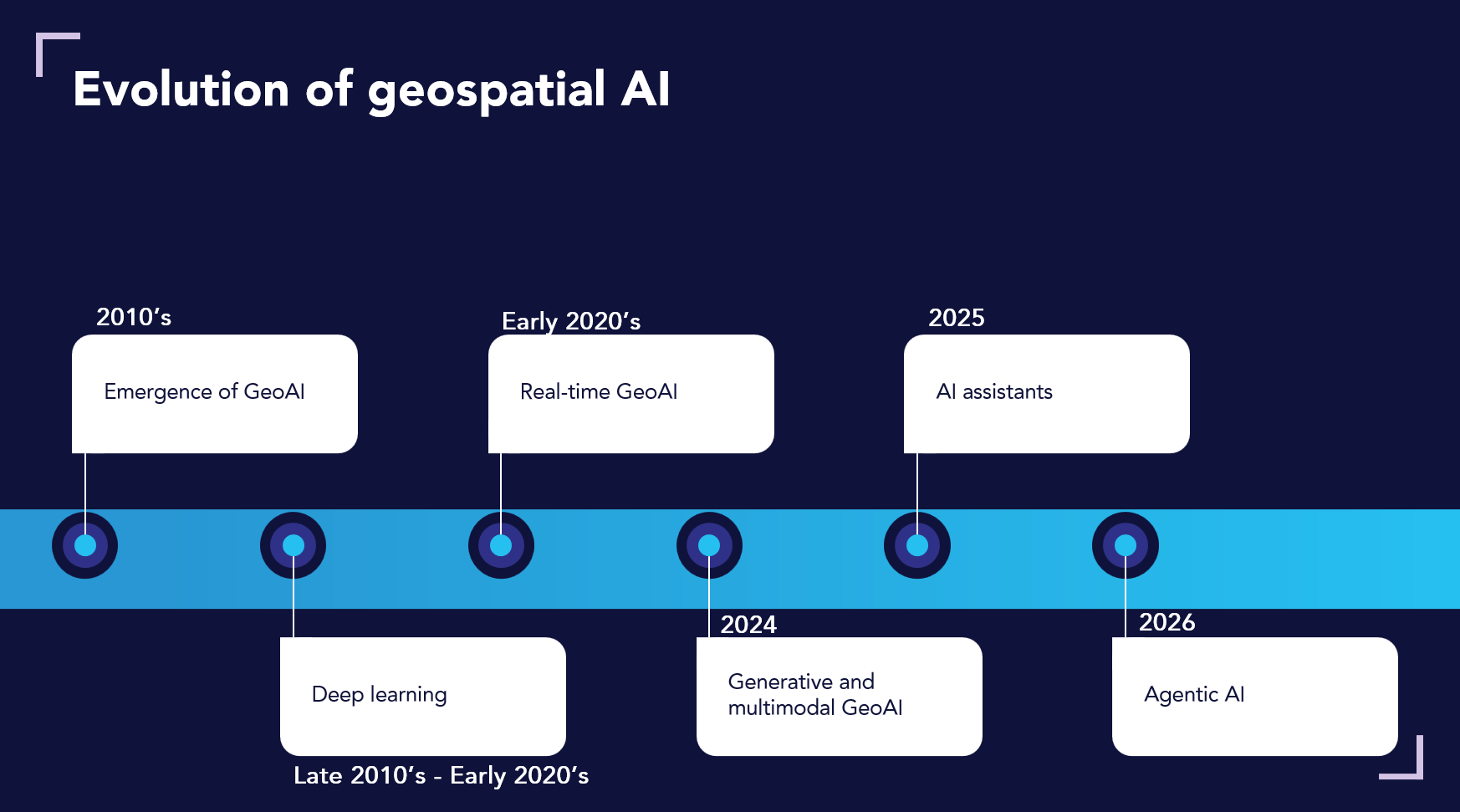
Each stage has built on the last, resulting in a broad and increasingly powerful set of AI tools designed to support real-world geospatial workflows
The current AI landscape
Writing in mid-2026, AI has become a strategic pillar of the ArcGIS platform. At Esri, we now offer a growing portfolio of AI-powered capabilities across our products, with many more in active development. These capabilities span GeoAI, AI Assistants and MCP-enabled integrations, all designed to help users achieve more with their data.
Rather than replacing GIS expertise, these tools are designed to augment it. Take the Arcade Assistant as an example, users can describe logic they need in plain English and receive a working Arcade expression, along with an explanation and suggestions for refinement. This not only supports everyday workflows, but also helps users to learn by example. The AI assistant will expose them to Arcade syntax, functions and approaches they may not have discovered independently or would need to dedicate specific development time to learn. As a result, users can both increase their immediate productivity and build confidence in their skills over time.
This growing ecosystem of AI capabilities does signal a shift in how people interact with spatial tools, making GIS more accessible whilst helping experienced analysts work more efficiently than ever before.
Why so many AI tools?
So, you might have the impression that there are quite a few AI tools across ArcGIS, and you wouldn’t be wrong, but why are there so many?
Think about tools such as Microsoft Copilot or ChatGPT, their value comes not only from enhancing productivity but also from being embedded within the tools and workflows where you need them. Copilot is in your browser and your desktop applications, like Word, Excel and PowerPoint, with each implementation designed to help users complete specific tasks in context.
It’s also important to recognise the distinction between consumer and enterprise AI experiences. Public, consumer AI tools are typically trained on large datasets and may use the user’s interactions to improve their models. Enterprise solutions such as Microsoft 365 Copilot are designed around an organisation’s existing security, permissions and compliance policies. This allows users to benefit from AI assistance while maintaining control over business-critical information.
ArcGIS follows the same principle. Rather than providing a single AI capability, at Esri we are embedding purpose-built AI experiences where they deliver the most value. The support our users need in ArcGIS Pro is different to the support needed in ArcGIS Business Analyst, and this is why we see multiple AI tools emerging. They are tailored to the workflows, questions and challenges within each tool or application.
It is not about having more AI. It is about having the right focused AI in the right place at the right time. Privacy and security sit at the heart of how we design and deploy these capabilities.
Esri’s approach to security, privacy and trust
As AI Assistants become more integrated into everyday workflows, trust, security and privacy become even more important. At Esri, we recognise the immense value these tools bring to ArcGIS users and we are equally committed to ensuring the underlying technology is reliable, transparent and responsibly designed.
We also understand that the adoption of AI is not solely about capability, it is about confidence. Organisations must be able to leverage AI while maintaining control over where their data resides, how it is accessed and how it is governed. Information security, data sovereignty and responsible AI practices are therefore fundamental considerations in the design and deployment of AI capabilities in ArcGIS.
This is why the ArcGIS Trust Centre is an important part of Esri’s AI journey. It reflects our commitment to responsible and ethical development, providing clear insight into the principles that guide our work. We are committed to ensuring that users can benefit from increased productivity and improved workflows without compromising on security, privacy, transparency, fairness, reliability and accountability.
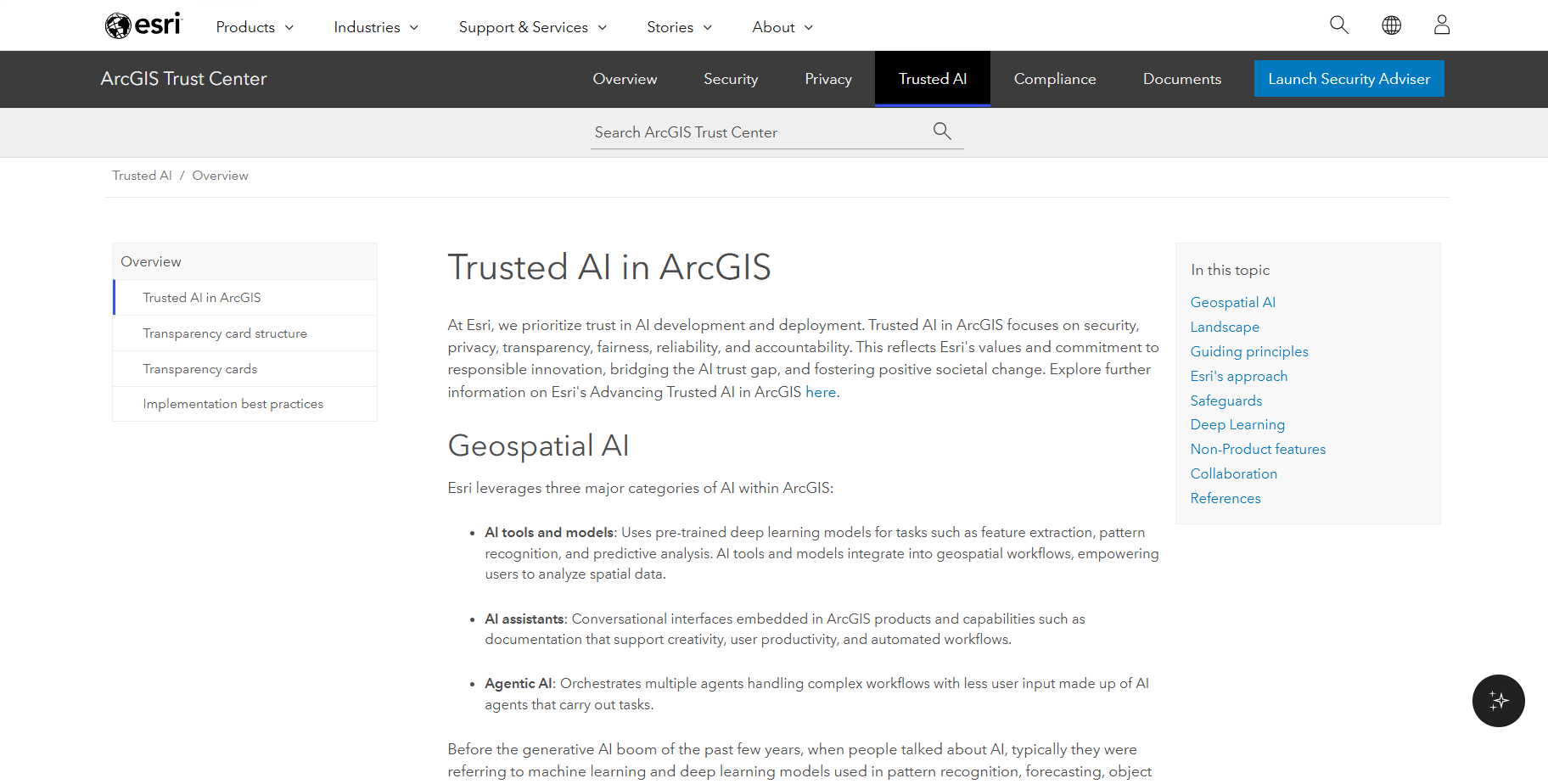
You can explore the Trust Centre here.
The Trust Centre exists to give users and organisations confidence, not just in how their data is handled behind the scenes, but in how our AI systems behave. At a time when understanding AI is more important than ever, we want users to have clarity on how these tools operate. This includes transparency for each AI Assistant we provide. Our Transparency Cards offer detailed information about every assistant, including how it works and the principles guiding its development.
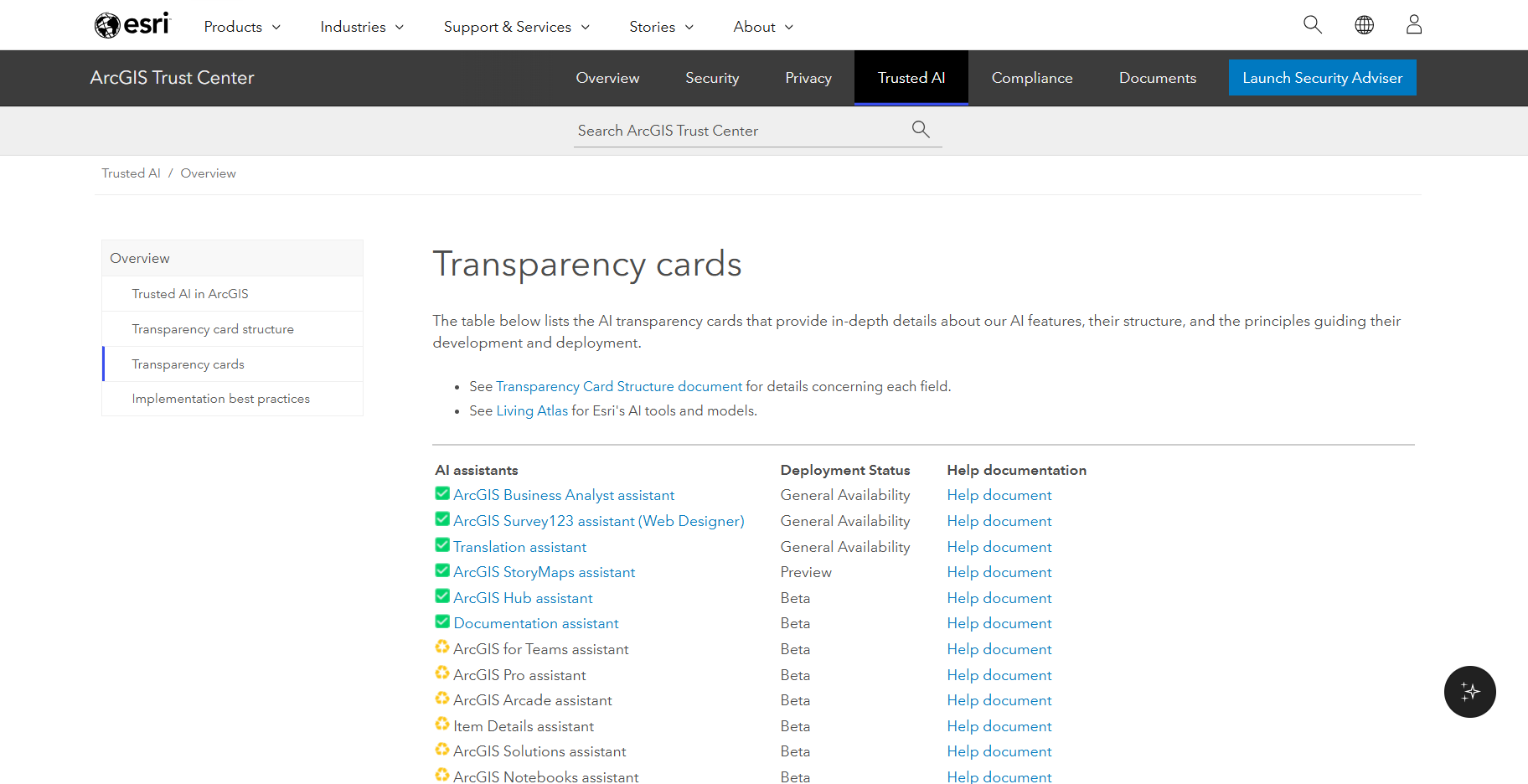
You can view individual transparency cards here.
As you can see, we take our responsibility as the software provider seriously. We use measures such as human in the loop design, customer opt in and opt out controls and strict data protection practices, and we continue to ensure our capabilities evolve with regulatory requirements.
Trust in AI is a shared responsibility though, and we encourage organisations to apply appropriate oversight when adopting any AI tools.
Key takeaways
AI in ArcGIS is not a single feature or tool. It is an evolving capability woven across the entire system.
From deep learning and GeoAI through to Assistants, each step is making GIS more accessible, more efficient and more intuitive. That is why you are seeing AI appear across ArcGIS. Each capability is tailored to the workflows and needs of its application.
As these capabilities grow, so does the responsibility that comes with them. For us, advancing AI is not just about what the technology can do. It is about how it is built, how it behaves and how it earns trust. That means giving organisations clarity on how their data is handled, ensuring strong security foundations and being transparent about how AI systems operate. The ArcGIS Trust Centre is our way of sharing this openly with our users.
As the geospatial industry continues to evolve, the focus is not just on developing AI. It is about giving individuals and organisations the confidence to adopt and use AI to its full potential.