Optimising NHS estate management with a digital twin
One of the UK’s largest NHS trusts, Manchester University NHS Foundation Trust (MFT) has developed a digital twin of eight hospitals and mapped its estate of more than 300 buildings. Achieved using Esri’s ArcGIS technology, this connected view of buildings, spaces and assets is helping the trust to optimise the management, maintenance and utilisation of its vast estate and make better-informed decisions that support patient care.
ArcGIS integrates data from multiple disconnected systems and paper files, creating a shared, accessible view of estates information
The interiors of eight hospitals have been mapped in detail, using ArcGIS Indoors, showing which clinical services use which spaces
Digitising RAAC and asbestos surveys is estimated to save ten days of effort every month at just one hospital alone
The Challenge
With overwhelming demand for healthcare services and limited resources, NHS trusts face difficult decisions about how to manage their estates safely, efficiently and effectively. The questions they ask are complex. Which clinical services are operating in areas with reinforced autoclaved aerated concrete (RAAC), for instance, and how can maintenance activities be planned to minimise disruption? Equally, where are new community midwife services most needed, is there space within an existing building and is this location on a good bus route?
MFT wanted to be able to find reliable answers to questions just like these quickly, but didn’t have easy access to information about its large estate. Information about more than 300 buildings was dispersed across multiple, incompatible IT systems and paper files, and there was no single source of estates information that managers could rely on to give them the answers they needed.
“Our digital twin gives us accurate, detailed information and analytical tools, so that we can find answers to complex questions and make better-informed decisions to meet the needs of clinicians and patients”
David Bailey, Head of Digital Estates, Manchester University NHS Foundation Trust
The Solution
In a major estates digital transformation project, MFT used Esri’s ArcGIS technology to create a connected digital model of eight hospitals, known as a digital twin, alongside wider mapping of its estate. It was supported by the data partner BIS Consult, which defined the underlying data strategy and integrated data from multiple legacy systems including computer-aided facility management data, computer-aided design (CAD) plans and asset inventories.
Built using ArcGIS Online and ArcGIS Indoors, the interactive digital estates map shows the locations of all the trust’s buildings, including those leased for community healthcare services. Users can explore the map in 2D or 3D, see individual buildings, green spaces, car parks and other facilities on hospital sites and click on them to bring up more information about their design, condition and current use.
Within the digital twin of the eight hospitals, 384,000 square metres of interior space have been modelled in detail, showing individual treatment rooms, surgical theatres and offices, all colour coded according to the clinical service area that occupies them. With a few clicks, it is possible to see which team is using which space, on which floor. It is, therefore, easy to visualise, for example, where a dermatology outpatient clinic is in relation to main corridors and stairwells to better understand patient journeys through a hospital.
MFT’s digital twin is constantly expanding and the trust plans to extend the detailed model to all ten of its hospitals, as well as include additional data from building condition surveys. Looking ahead, the trust has exciting plans to use remote sensors and internet-connected devices to enrich the digital twin with real time data. It also plans to use its digital twin as the foundation for new digital wayfinding solutions, helping patients and visitors navigate around hospital sites.
“Integrating all of our existing data into one 3D model using ArcGIS is driving new opportunities for efficiency gains and service improvements.”
David Bailey, Head of Digital Estates, Manchester University NHS Foundation Trust
The Benefits
Optimal use of hospital space and assets
At a time when NHS waiting lists are long, the digital twin helps MFT answer critical questions about how to optimise space in its hospitals. MFT is trialling how the digital twin can identify underused space across hospitals and help teams assess whether rooms could accommodate additional clinical activity. MFT is also considering putting radio-frequency identification (RFID) tags on movable assets like beds, wheelchairs and trolleys, in the future, to monitor their locations in real time and ensure that they too are fully optimised.
Improved patient and staff safety
The digital twin gives MFT clearer visibility of risks, such as asbestos, enabling it to better understand the scale of issues across the entire estate. New survey data about asbestos is available in the digital twin the following day, after verification by the Asbestos Management team, in a digital process that is estimated to save ten days of effort per month at one hospital alone. The trust can then plan essential maintenance more effectively and make more informed decisions about the safety measures needed to manage risks and protect patients and staff.
A pathway to more cost-efficient maintenance
The digital twin provides MFT with a broader picture of maintenance requirements, across the entire estate. Whereas maintenance teams used to have to consult multiple systems when planning maintenance, they can now easily see how spaces are used and minimise potential disruption to patients and staff. In time, the Estates Team anticipates that it will be able to prioritise resources and group similar maintenance tasks in similar locations together, so they can be completed more cost-efficiently.
Well-informed strategic decision-making
When planning for the future, MFT can use the digital twin to analyse estates data in conjunction with local and population data and answer questions about where to locate new services. For example, a recent study helped identify suitable locations for potential new midwifery centres in Manchester, taking into account capacity in existing buildings, hot spots of population growth and strong public transport links.
Targeted sustainability planning
As the digital twin develops, MFT plans to bring together energy usage, carbon emissions and environmental factors across the estate to create more targeted sustainability action plans in the future. The trust has, for instance, begun to identify the rooms and buildings worst affected by recent heatwaves, investigate the causes of high indoor temperatures, identify other areas potentially at risk and prioritise remedial measures, such as the installation of heat-reflecting window screens.
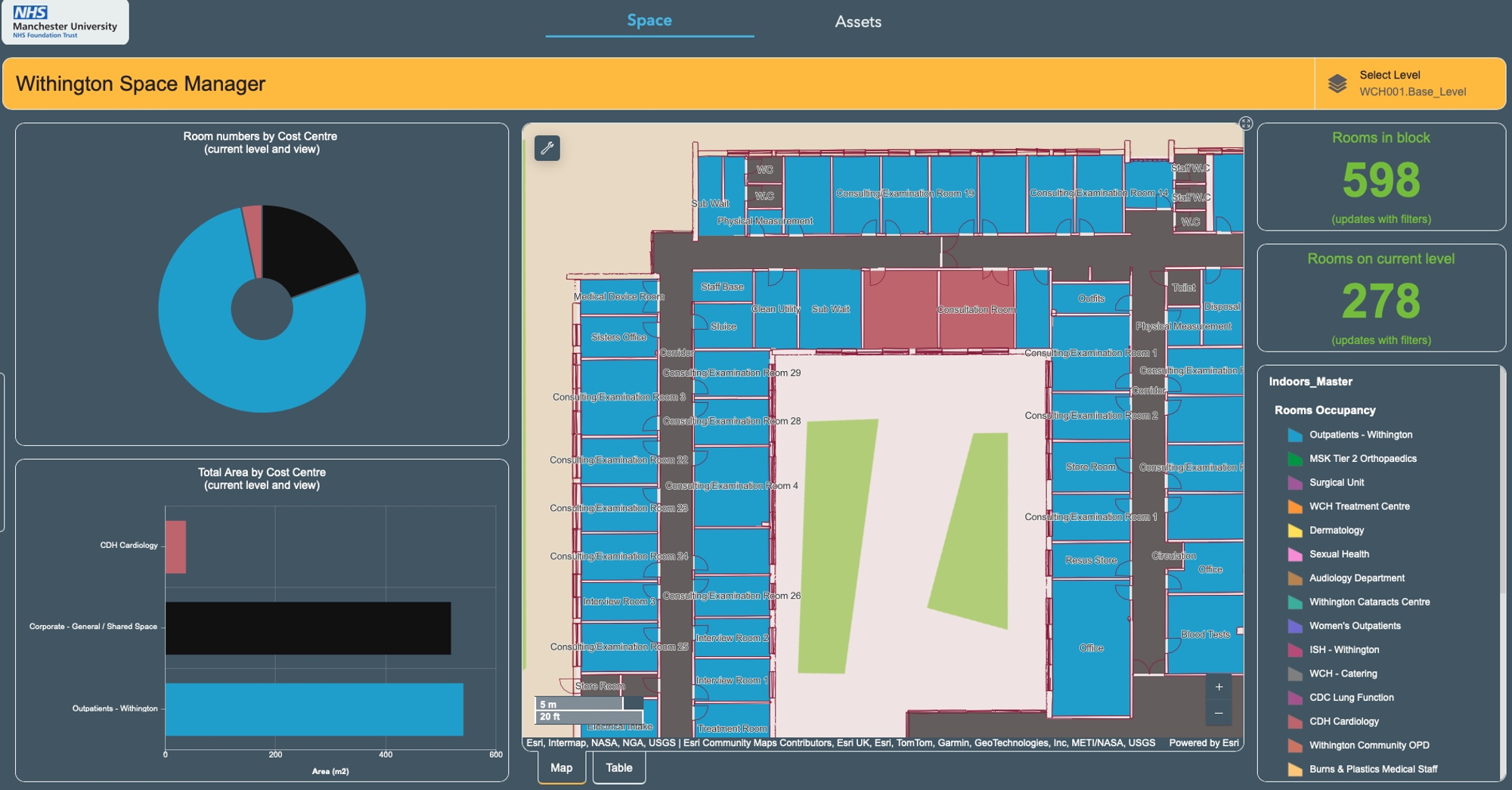
An ArcGIS dashboard showing room allocation and utilisation by block and floor.