Claire Evans is an educator with a passion for geographic information system (GIS) technology. Head of Geography at Bloxham School in Oxfordshire, she came up with an idea for an extra-curricular activity that would help young people gain practical GIS and workplace skills. Her idea quickly gained momentum, developing into a sustainability challenge that helps students develop into confident, informed problem-solvers. The ground-breaking scheme, developed in partnership with Dalcour Maclaren, has expanded rapidly and now involves over 100 teams from more than 35 schools nationwide.
Space for GIS
Evans first encountered GIS while studying geography at Liverpool University and completing a PHD in economic geography at the University of Bristol. After lecturing in the School of Geographical Sciences at the University of Bristol for four years, she realised that she wanted to inspire people from a younger age and moved to Bloxham School, where she has been teaching geography to students aged eleven to eighteen for over twenty years.
Keen to incorporate GIS into her lessons, Evans attended several GIS training courses to learn new ways of using and teaching GIS. She always came away feeling really inspired, but then struggled to build GIS fully into her lessons due to the constraints of the national geography curriculum. As she needed to focus on exam preparation, she simply didn’t have time in lessons to teach pupils in-depth skills in GIS. “It was very difficult to give GIS the space it deserved, particularly across the GCSE and A-level exam years,” Evans explains.
Bloxham School had free access to Esri’s ArcGIS Online technology through Esri UK’s ArcGIS For Schools Programme, so the obstacle wasn’t a lack of specialist technology. “We just didn’t have the time in lessons to expose our students to the industry-level GIS capabilities that Esri UK gave us free of charge,” laments Evans. “ArcGIS is such a powerful tool, and I wanted to really show pupils how they could navigate huge datasets and explore patterns in a very easy, visual way.”
It was from this frustration that the idea emerged to ‘make space’ for GIS by devising an extra-curricular activity. Evans and her colleagues in the geography department decided to challenge students to use GIS and real-world data to investigate a sustainability issue. They were keen for the initiative to be student-led and based on scenarios that were contemporary and purposeful.
The sustainability challenge
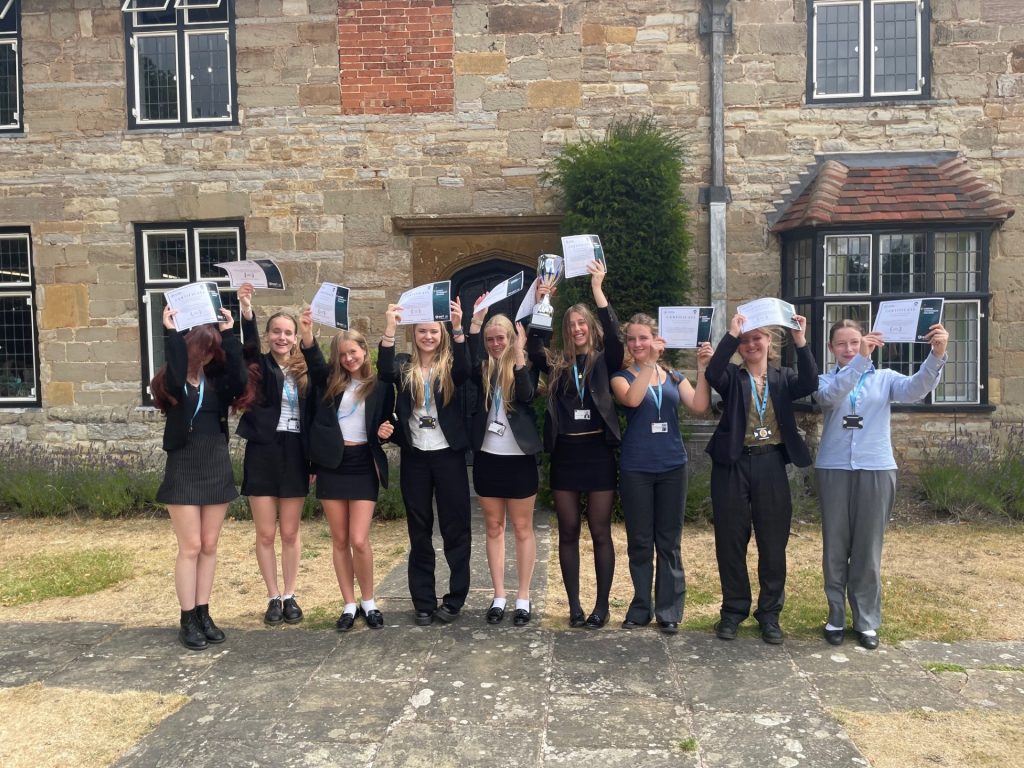
Named the Bloxham Sustainability Challenge, the extra-curricular programme was developed in collaboration with Dalcour Maclaren, a consultancy that unlocks land consents for the utilities and infrastructure sector. In the first year, a group of students from Bloxham School were challenged to evaluate a proposed solar park at Buckland Marsh. Using a range of ArcGIS tools, they had to decide if the project should go ahead and, if so, where the cables connecting the site to the national grid should be routed. “Once the students were signed up with the ArcGIS platform, I couldn’t believe how quickly they just got it,” recalls Evans. “They were adding and analysing data and asking questions—and this was really exciting to see.”
The following year, seven teams engaged in the challenge from three schools across Oxfordshire and Warwickshire. They used ArcGIS Online to visualise proposals for a new reservoir in Abingdon, understand the implications for water supply and analyse the impacts on the environment. They also used ArcGIS Survey123 to collect data in the field and survey the opinions of local residents, community groups and other stakeholders. As Evans says, “ArcGIS enables students to grapple with real-world problems and find ways to navigate around them.”
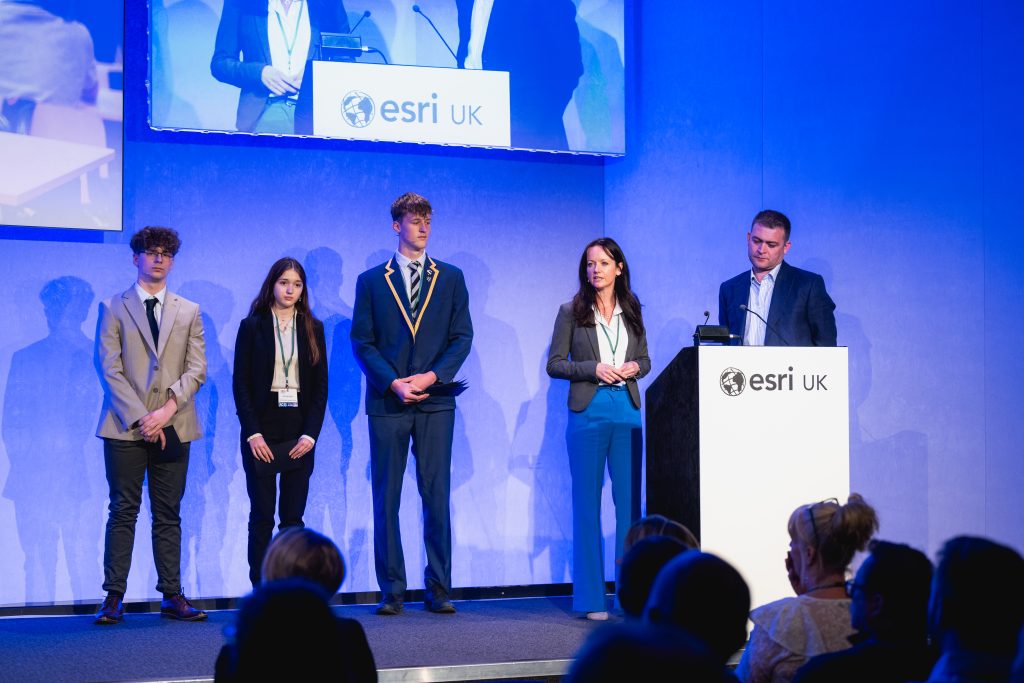
After Evans and three pupils delivered a presentation about the Bloxham Sustainability Challenge at the Esri UK Annual Conference, interest in the programme intensified. The Royal Geographical Society promoted the challenge too and, within months, Evans received interest from over 35 schools, from the Isle of Wight to Aberdeen. Understandably delighted, she began to work with Dalcour Maclaren to scale up the programme and, in September 2025, the Bloxham Sustainability Challenge entered into a national pilot phase.
This year’s challenge uses data from Vattenfall, one of Europe’s largest producers and retailers of electricity and heat. Participating teams have been challenged to consider if an on-shore wind farm should go ahead and, if so, at which of seven potential locations in East Ayrshire. Students are looking at the impacts—positive and negative, short term and long term—and taking into account a wide range of factors from transportation and employment to pollution when making their decisions. “Students will, of course, need evidence to back up their proposals, and that’s why they need GIS,” says Evans.
Skills for future careers
Evans is convinced that the Bloxham Sustainability Challenge enables students to develop valuable skills for their future careers, something that is very important to her. Before becoming Head of Geography, she was of Head of Careers, a position in which she helped create careers opportunities for students. She also previously worked as a mentor for the government-funded careers service, Connexions, and set up a consultancy business to help young people get grants for start-up businesses.
Students don’t just gain technology skills through participation in the Bloxham Sustainability Challenge; they also hone their skills in decision-making, analysing and evaluating information and grow in confidence speaking with professionals about complex topics. A series of ‘lightning lectures’ has been arranged for participants this year, with topics ranging from GIS techniques to project and time management. All this leads Evans to comment that “The Bloxham Sustainability Challenge is much more powerful than work experience. Students gain the skills they need to complete the challenge, but also for their next steps in life.”
Because the challenge is focused on sustainability projects, it deliberately opens students’ eyes to the range of jobs that exist within the green economy. “Our students are in a very different world from the one we entered,” Evans observes. “Climate issues are so much more prevalent and urgent. This project empowers students to take action through the use of GIS and shows them how they can make a real-world impact.”
The project is particularly effective in making young people more aware of the complexities of weighing up different priorities and perspectives. As one sixth form student recently put it: “The Bloxham Sustainability Challenge has given me an insight into the complications of establishing new developments – such as considering demand and resources, and balancing the concerns of locals with the needs of a wider population.” Lesson learned.
The power of partnership
Evans is keen to emphasise that the Bloxham Sustainability Challenge could not have come to life and thrived without Dalcour Maclaren’s input. The company’s professional experience, data and mentoring brings what Evans calls ‘real-world relevance’ to the challenge. This year, there are nine GIS mentors assigned to the challenge from Dalcour Maclaren, who provide support to the teams of students involved. “The Bloxham Sustainability Challenge is a truly collaborative project, built on our shared desire for true accessibility to sustainability-focussed education, which directly complements the scaling demand for climate awareness and geospatial skills within industry,” says Jo Middleton, Head of Talent Acquisition at Dalcour Maclaren.
Esri UK has also played a key role in the project, not just by providing free access to GIS technology, but by delivering training and support for students and teachers and judging final presentations. “Esri UK has been instrumental in the success of the Bloxham Sustainability Challenge,” says Evans. “There’s no way we would be where we are without Esri UK’s Schools team.”
The initiative has proven to Evans that the two worlds of industry and education must collide to help young people develop the skills that the world needs. “If we are to achieve our net zero targets in the UK, educators and industry leaders need to work much closer together to strengthen the talent pipeline,” she says. “We have got to start now with our students, to create the workforce for the future with a deeper understanding of climate challenges and the skills and the agency to do something about it.”
The Bloxham Sustainability Challenge is undoubtedly a pioneering and proven test case for what education and industry can achieve if these two worlds come together. “Ultimately what we, Dalcour Maclaren and Esri UK have achieved with the Bloxham Sustainability Challenge celebrates the power of partnership, and I do genuinely believe that this is the future of education,” concludes Evans. “We all need to make time for important, collaborative, educational initiatives like this.”
 Claire Evans - Bloxham School